
Which Surgical Method Should Be Used to Treat Benign Prostatic Hyperplasia?
When and by What Method Should Benign Prostatic Hyperplasia Be Treated Surgically?
Surgery is one of the most important treatment methods for benign prostatic hyperplasia. First and foremost, we must accurately determine which patients are suitable for surgical treatment. Of course, with advancements in technology, many new techniques have been developed in recent years, and the choice of which method to use remains a topic of debate worldwide.
While the techniques to be used have their own advantages and disadvantages, the surgeon’s experience plays the most important role in the success of the procedure.
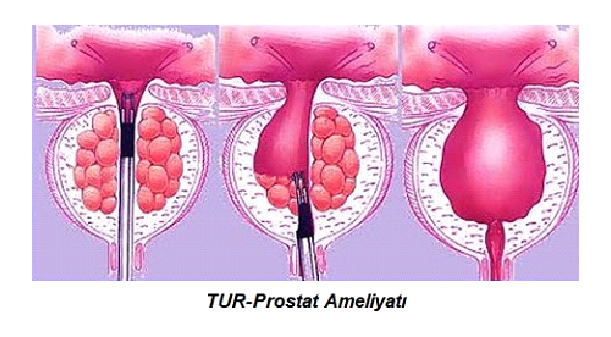
In patients with benign prostatic hyperplasia:
⦁ When symptoms do not improve despite medical treatment
⦁ When bladder stones form
⦁ When there is persistent bleeding from the prostate
⦁ When kidney failure develops due to an enlarged prostate
⦁ In cases of recurrent urinary retention
⦁ Surgical treatment is is indicated.
What Are the Surgical Options for Benign Prostatic Hyperplasia?
Surgical treatment for an enlarged prostate involves removing the part of the prostate that has grown and is blocking the urinary tract; there are several methods for this procedure:
⦁ Transurethral Resection of the Prostate – TURP
⦁ Transurethral Bipolar Enucleation
⦁ Holmium Laser Enucleation of the Prostate – HoLEP
⦁ Thulium Laser Enucleation of the Prostate – ThuLEP
⦁ Laser Prostate Vaporization – Greenlight
⦁ Open Surgery
Although the techniques to be used have their own advantages and disadvantages, the surgeon’s experience plays the most important role in the success of the procedure.
What Are the Advantages of Laser Prostate Surgery (HoLEP, Greenlight, ThuLEP)?
The main advantages of laser surgery (HoLEP, Greenlight, ThuLEP):
⦁ There is a lower risk of bleeding during and after surgery
⦁ The postoperative catheter can be removed much sooner
⦁ Discharge is possible 1–2 days
⦁ The long-term risk of disease recurrence is lower than with conventional closed surgeries
⦁ Since it does not damage the nerves running immediately alongside the prostate capsule, there is less impact on sexual function after surgery
