
Kidney Cancer
- What Is a Kidney Tumor?
- How Common Is Kidney Cancer?
- What Are the Risk Factors for Kidney Cancer?
- What Are the Symptoms of Kidney Cancer?
- How Do We Diagnose Kidney Cancer?
- How Is Each Stage Treated?
- What Are the Surgical Methods Used to Treat Kidney Tumors?
- How Is Metastatic Disease Treated?
- Can the Cancer Be Removed from a Kidney Tumor While Preserving the Kidney Itself?
- Partial Nephrectomy (Kidney-Sparing Surgery)
- Conclusion and Summary
What Is a Kidney Tumor?
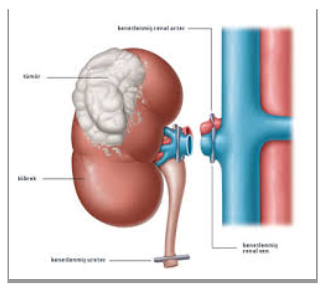
Kidney tumors can originate from the functional tissue of the kidney (renal parenchyma) or the collecting system (urothelium). Most are malignant and typically grow without causing symptoms, often being detected incidentally. The most common type of kidney cancer is renal cell carcinoma (RCC), which accounts for approximately 85–90% of kidney tumors.
Kidney cancer is being diagnosed at an earlier stage more frequently, particularly with the widespread adoption of advanced imaging techniques in recent years. As a result, treatment options have expanded, and minimally invasive surgical techniques have come to the forefront.
How Common Is Kidney Cancer?
Prevalence
- It accounts for 3% of all cancers in adults.
- It is most commonly seen in people between the ages of 50 and 70.
- It is diagnosed approximately twice as often in men as in women.
• In recent years, particularly with the widespread use of CT and MRI imaging, the detection rate of early-stage kidney cancer has increased.
What Are the Risk Factors for Kidney Cancer?
Environmental, genetic, and lifestyle factors play a role in the development of kidney cancer.
A) Environmental and Lifestyle Risk Factors
- Smoking → Doubles the risk of kidney cancer.
- Obesity → is a significant factor that increases the risk of renal cell carcinoma (RCC), particularly in women.
- Hypertension → Is an independent risk factor for the development of cancer.
- Dialysis Patients → Patients on long-term dialysis have a high risk of developing RCC associated with cystic kidney disease.
- Environmental Chemical Exposure → Long-term exposure to chemicals such as cadmium and trichloroethylene increases the risk of kidney cancer.
B) Genetic and Hereditary Risk Factors
Some inherited syndromes can increase the risk of kidney cancer:
- Von Hippel-Lindau (VHL) Disease → Tumors resulting from a VHL gene mutation (increased risk of bilateral RCC).
- Hereditary Papillary RCC Syndrome → Is caused by a mutation in the MET proto-oncogene.
- Birt-Hogg-Dubé Syndrome → Is associated with renolymphocytoma and hybrid RCC tumors.
What Are the Symptoms of Kidney Cancer?
📌 Early-stage kidney tumors usually do not cause symptoms, and most are detected incidentally.
2.1. Clinical Symptoms
The classic triad of kidney tumors (hematuria, flank pain, and a palpable mass) is observed in less than 10% of patients.
- Hematuria (Blood in the Urine) → This is the most common symptom (40–50%)
- Side Pain → There may be dull, constant, or intermittent pain in the lumbar region.
- Palpable Mass → Can be felt in large tumors.
- Fatigue, Weight Loss, and Fever → Common in advanced stages.
- Hypertension or Polycythemia → May develop due to the tumor’s hormonal effects.
2.2. Symptoms That May Occur in Metastatic Disease
Kidney cancer often metastasizes to the lungs, bones, liver, and brain.
- Lung metastases → Chronic cough, shortness of breath, hemoptysis (blood-tinged sputum).
- Bone metastases → Bone pain, pathological fractures.
- Liver metastases → Jaundice, elevated liver enzymes.
How Do We Diagnose Kidney Cancer?
3.1. Imaging Methods
- Ultrasonography (USG) → First-line imaging method.
- Computed Tomography (CT) Urography → It is the gold standard diagnostic method.
- Magnetic Resonance Imaging (MRI) → It is preferred without contrast in patients with kidney failure.
- PET-CT → Used to investigate metastatic disease.
3.2. Laboratory Tests
- Complete Blood Count (CBC) → Anemia or polycythemia is assessed.
- Kidney Function Tests (Creatinine, GFR)
- Alkaline Phosphatase (ALP) and Calcium → These are evaluated for bone metastases.
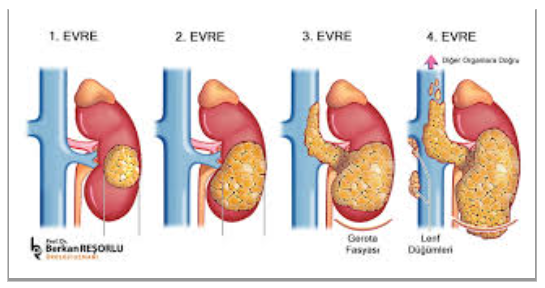
Early-Stage (Localized) Kidney Cancerni (T1-T2) How Do We Treat It?
- Surgical treatment (nephrectomy or partial nephrectomy)
- T1a (<4 cm) tümörlerde böbrek koruyucu cerrahi (parsiyelnefrektomi) tercih edilir.
Locally Advanced (T3-T4) and Metastatic Disease?
- Surgery + Systemic Therapy (Immunotherapy and Targeted Therapies)
What Are the Surgical Methods Used to Treat Kidney Tumors?
5.1. Radical Nephrectomy (Complete Removal of the Kidney)
- It is used for T2 and larger (>7 cm) tumors.
- Minimally invasive surgery (robotic or laparoscopic) is preferred.
5.2. Partial Nephrectomy (Kidney-Sparing Surgery)
- T1a (<4 cm) tümörlerde altın standarttır.
How Is Metastatic Disease Treated?
The decision to proceed with surgery or medical treatment is based on the patient’s overall condition, blood test results, and metastatic burden.
- Targeted Therapies (Tyrosine Kinase Inhibitors – TKI)
- Immunotherapy (Checkpoint Inhibitors)
Can the Cancer Be Removed from a Kidney Tumor While Preserving the Kidney Itself?
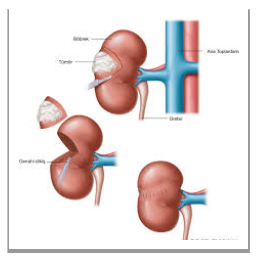
Yes, in cases of kidney tumors, it is possible to remove only the cancerous tissue while preserving healthy kidney tissue. This procedure is called a partial nephrectomy (kidney-sparing surgery) and is the preferred method, particularly for small and medium-sized kidney tumors (stages T1a–T1b).
In What Situations CanaPartialNephrectomy(Kidney-Sparing Surgery) Be Performed?
Partial nephrectomy can be performed in patients who meet certain criteria:
✅ T1a Evresi (Tümör <4 cm) → Altın standart tedavi
✅ Stage T1b (tumors between 4 and 7 cm) → Preferred in suitable patients
✅ Patients with a single kidney → Radical nephrectomy can lead to kidney failure
✅ Bilateral kidney tumors → To preserve both kidneys
✅ Patients with chronic kidney disease or low kidney function reserve
✅ The tumor is located in the periphery of the kidney rather than at its center → This is important for ensuring that sufficient functional tissue remains after surgery
Less-than-truckload Nephrectomy Which Surgical Method Can Be Used?
The surgery can be performed using three different techniques:
🔹 Open Partial Nephrectomy:
- It is preferred for large tumors or those that are difficult to localize.
- It requires a larger surgical incision.
🔹 Laparoscopic Partial Nephrectomy:
- It is performed minimally invasively using small incisions.
- It offers less pain and a faster recovery time.
🔹 Robotic Partial Nephrectomy:
- It is performed using the Da Vinci robotic surgical system.
- It provides superior surgical precision and better visualization.
- It results in less bleeding and a shorter hospital stay.
📌 Robotic partial nephrectomy offers significant advantages, especially when the tumor is located in hard-to-reach areas of the kidney.
Less-than-truckload What Are the What Are the Advantages of a Partial Nephrectomy?
- Preserving kidney function → Is vital for patients with a single kidney or those with chronic kidney disease.
- It has the same oncological success rate for small tumors → Compared to radical nephrectomy, there is no difference in long-term survival for small tumors (T1a).
- No change in the risk of metastasis → In small tumors, the risk of metastasis following partial nephrectomy is similar to that following radical nephrectomy.
- Faster recovery with minimally invasive surgery → By leveraging the advantages of robotic or laparoscopic surgery, patients can enjoy a shorter hospital stay and a faster recovery.
Less-than-truckload When Is a Nephrectomy Not Appropriate?
- Large Tumors (>7 cm, T2 and above) → Radical nephrectomy may be more appropriate.
- Envelopment of the renal vessels by the tumor or spread to the renal sinus → May pose a risk in terms of oncological outcomes.
- If the tumor is located in the central part of the kidney and very close to the hilum → Technically, a partial nephrectomy may be difficult.
- Multifocal tumors (patients with multiple tumor foci) → It may not be possible to adequately preserve the functional portion of the kidney.
Conclusion and Summary
- Kidney cancer usually has no symptoms, and most patients are diagnosed incidentally.
- Minimally invasive procedures (robotic/laparoscopic) are becoming increasingly common.
- In stages T3 and T4, immunotherapy and targeted therapies are required in addition to surgery.