
What Is Peyronie's Disease?
- What Is Penile Curvature?
- How Common Is Penile Curvature?
- How Does Penile Curvature Develop?
- Symptoms of Penile Curvature
- How Is Penile Curvature Diagnosed?
- Is There a Treatment for Penile Curvature?
- How Much Improvement Can Be Expected with Non-Surgical Treatments?
- When Is Surgery Necessary for Penile Curvature?
- What Happens If Penile Curvature Is Left Untreated?
- Frequently Asked Questions
PEYROIE'S DISEASE – WHAT IS PENILE CURVATURE?
Penile curvature is a common but often unspoken-about condition in men that is significant
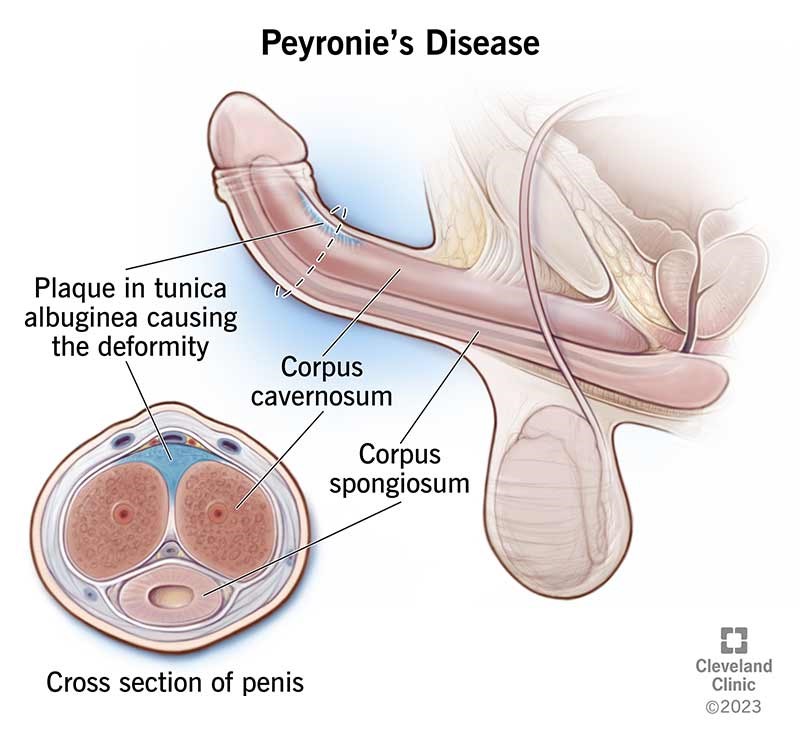
It is a sexual health problem. Known in medicine as Peyronie’s disease, this condition occurs when a hard plaque (fibrotic tissue) forms in the layer of connective tissue within the penis, causing the penis to curve to one side during an erection. While the curvature may sometimes be mild, in some men it can be severe enough to interfere with sexual intercourse.
This article serves as a comprehensive resource designed to explain in great detail the causes, symptoms, diagnostic methods, treatment options, disease stages, and modern approaches to penile curvature.
1. What Is Penile Curvature? (Scientific Definition)
When plaque forms in the tunica albuginea —a layer of connective tissue surrounding the structures responsible for penile erection—that area cannot stretch sufficiently during a normal erection, and the penis bends toward the side where the plaque is located.
This curvature can be:
• Upward,
• Downward,
• To the right or left,
• S-shaped,
• Circular (complex curvature).
Penile curvature is not merely an aesthetic issue; it can sometimes make sexual intercourse difficult, cause pain, affect erections, and lead to significant psychological anxiety.
2. How Common Is Penile Curvature?
According to scientific data:
• Lifetime prevalence: 8%–10%,
• Prevalence among those over 40: 12%–20%,
• Prevalence among men with erectile dysfunction: up to 25%.
It is believed that the actual rates are higher because many men do not discuss this issue with their doctor.
3. How Does Penile Curvature Develop? (The Mechanism of Peyronie's Disease)
The primary cause of penile curvature is fibrotic plaques that form within the tunica albuginea.
The mechanism of this process is as follows:
Microtrauma:
Sudden and intense strain on the penis during sexual intercourse can cause microtears.Inadequate healing response:
As the body tries to repair this damage, it may form stiffer tissue instead of healing normally.Development of fibrosis:
During the healing process, excessive collagen is produced and the tissue hardens.Plaque formation:
Over time, this hard tissue turns into plaque, and its elasticity decreases.
: Because the area with the plaque cannot stretch during an erection, the penis bends to one side.
4. Causes of Penile Curvature
There is no single cause of penile curvature; in most cases, multiple factors play a role.
A) Sexual Trauma (Most Common Cause):
Twisting of the penis, improper angles, “top partner” positions, and uncontrolled movements can lead to microtears.
B) Age-Related Tissue Weakness
C) Vascular Problems and Blood Flow Disorders
D) Diabetes
E) Genetic Predisposition
F) Connective Tissue Disorders
G) Smoking and Alcohol
5. Symptoms of Penile Curvature (Conditions Men Notice Most Often)
Penile curvature presents with the following symptoms:
✔ Noticeable curvature during an erection,
✔ A hard, pea-like plaque on the penis,
✔ Pain during an erection,
✔ Shortening of the penis,
✔ Decreased erection quality,
✔ Difficulty during sexual intercourse,
✔ Psychological anxiety and loss of self-confidence.
The degree of curvature can range from 20° to 90°.
6. Stages of Peyronie's Disease (Acute – Chronic)
Peyronie's disease progresses in two stages:
A) Acute Phase (6–18 Months)
• The curvature changes constantly,
• The plaque is soft,
• Pain is common,
• There may be a burning sensation and tenderness in the penis,
• Non-surgical treatments are most effective during this period.
B) Chronic Phase (After 18 Months)
• The curvature stabilizes,
• The pain usually goes away,
• The plaque hardens and may calcify,
• Surgery may be necessary,
• The effectiveness of non-surgical treatments may decrease, but they are still beneficial.
7. Types of Penile Curvature
Penile curvature can manifest in various forms:
Dorsal (Upward) – The most common,
Ventral (Downward),
Lateral (Right or Left),
S-Shaped Complex Curvature,
Watch Dial Warping,
Circular / Deformation Curvatures (Hourglass Deformity).
8. How Is Penile Curvature Diagnosed?
The diagnosis is often made based on the patient’s history and a physical examination.
Patient history:
• When the curvature began,
• Whether there is pain,
• Erectile quality,
• Complaints of shortening,
• Angle of curvature.Physical examination:
The orientation, hardness, and location of the plaques are determined.Additional tests, if necessary:
• Penile Doppler Ultrasound,
• Curvature analysis using photographs,
• Assessment of fibrosis density.
9. Is There a Treatment for Penile Curvature?
Yes, penile curvature is a treatable condition.
The treatment approach varies depending on the severity and stage of the curvature, as well as the patient’s symptoms.
Treatment options:
A) Non-surgical treatments,
B) Treatments requiring surgery.
10. Non-Surgical Treatments for Penile Curvature (Scientifically Proven Methods)
The following treatments are modern methods currently used worldwide.
1) ESWT – Shock Wave Therapy
Mechanism of action:
• Softens the plaque area,
• Increases microvascularization,
• Significantly reduces pain,
• Promotes breakdown of fibrotic tissue.
Effect:
• 15–35% improvement in curvature,
• 70% reduction in pain.
Who is it suitable for?
• Acute phase,
• Painful curvatures,
• Moderate curvature.
2) Traction Device (Penile Stretching Therapy)
It is the most effective non-surgical method for correcting deformities. FDA-approved devices are available at
.
Mechanism of action:
• Remodeling of the tunica albuginea,
• Relaxation of tissue in the plaque region,
• Preservation of penile length.
Effect:
• 20–45% improvement in curvature,
• 1–3 cm increase in length.
Usage:
• 1–3 hours per day, for a total of 3–6 months.
3) PRP (Platelet-Rich Plasma)
It involves applying platelet-rich plasma to the plaque site.
Mechanism of action:
• Reduces fibrosis,
• Supports tissue regeneration,
• Softens hardened plaque.
Effect:
• 10–25% improvement in curvature.
4) Exosome Therapy
It is an advanced form of PRP therapy.
Mechanism of action:
• Accelerates cell renewal,
• Increases elasticity,
• Thins plaque.
Effect:
• 20–35% improvement in curvature.
5) Oral Medications
Pentoxifylline:
• It is the most commonly used medication,
• It suppresses fibrosis,
• It is effective against calcified plaques.
PDE5 inhibitors (tadalafil, etc.):
• Improves blood flow,
• Improves erections.
Antioxidants:
• Coenzyme Q10,
• L-Carnitine,
• Vitamin E.
6) Creams, Gels, and Topical Treatments
They are not sufficient on their own, but they can be used as a supplement.
11. How Much Improvement Can Be Expected with Non-Surgical Treatments?
| Treatment | Average Improvement |
|---|---|
| ESWT | 15–35% |
| Traction | 20–45% |
| PRP | 10–25% |
| Exosome | 20–35% |
| Combination therapy | 40–60% |
The greatest success is achieved through combined protocols that involve the simultaneous use of multiple methods.
12. Home Remedies for Penile Curvature
These methods are not a treatment on their own, but they provide support:
• Regular pelvic floor exercises,
• Heat therapy,
• Avoiding trauma,
• Avoiding positions that strain the erection,
• Quitting smoking,
• Blood sugar control.
13. When Is Surgery Necessary for Penile Curvature?
Surgery is more appropriate in the following situations:
• Curvature greater than 60 degrees,
• Sexual intercourse is not possible,
• The plaque is completely calcified,
• Significant shortening of the penis,
• Chronic stage + marked deformity.
14. What Happens If Penile Curvature Is Left Untreated?
Untreated penile curvature:
• The condition may worsen,
• Penis shortening may progress,
• Erectile dysfunction may develop,
• Psychological effects may increase,
• It may reduce the quality of sexual relations.
That is why early intervention is important.
15. Frequently Asked Questions
Does penile curvature resolve on its own?
In the acute phase, 10–15% of cases may resolve on their own. In the chronic phase, it does not resolve on its own.
Does sexual intercourse increase the risk of curvature?
In some positions, the risk of injury may increase.
Does a curvature cause pain?
Pain is common during the acute phase.
Will treatment completely cure it?
It depends on the stage; high success rates are possible with combination therapies.
What causes penile shortening?
Because the area with plaque cannot stretch.
16. Conclusion: Penile Curvature Is a Treatable Sexual Health Problem
Penile curvature is a common condition in men that affects quality of life.
With early diagnosis and proper treatment:
• Curvature can be reduced,
• Penile length can be preserved,
• Pain can be eliminated,
• Sexual function can improve.
Non-surgical treatments are particularly successful during the acute phase of the disease.
Significant improvement can also be achieved in the chronic phase using the right methods.
Penile curvature is nothing to be ashamed of; effective treatments are available in modern medicine.