
Surgery Office

0543 333 33 34

Whatsapp & Mobile

0543 333 33 34

İletişim

Location Map

Comments & Opinions

Patient Opinions

Muayenehane

0322 503 80 70

Whatsapp & Mobile

0543 333 33 34

Yorumlar & Görüşler

Hasta Görüşleri

Penile Implant

What Is a Penile Prosthesis (Penile Implant)?

Penile prostheses are medical devices surgically placed into the penis for patients experiencing erectile dysfunction. They are especially effective for patients who do not respond to medications or other treatments. The prosthesis mimics the natural erection mechanism, helping the patient achieve sufficient rigidity for sexual intercourse.

How Many Types of Penile Prostheses (Penile Implants) Are There?

Penile prostheses are divided into two main groups:


A) Inflatable (Hydraulic) Penile Prostheses

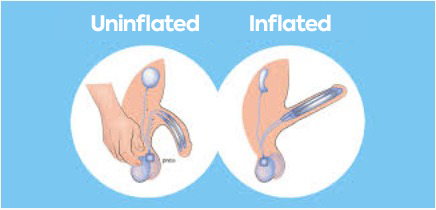
This is the most advanced and natural-looking type of implant. It works with a fluid-filled system that allows the patient to achieve an erection as needed.

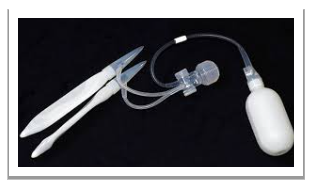
1) Three-Piece Inflatable Penile Prosthesis

Structure:

  • Silicone cylinders (placed inside the penis)

  • Pump (placed in the scrotum and operated manually by squeezing)

  • Reservoir (placed in the abdomen to store the fluid)

Advantages:

  • Provides the most natural erection and flaccidity

  • When erect, it looks and feels like a natural penis

Disadvantages:

  • The surgical procedure is more complex

  • Risk of mechanical failure (though new-generation implants are highly durable)
2) Two-Piece Inflatable Penile Prosthesis

Structure:

  • Silicone cylinders and pump are combined into one unit, pumping the fluid directly into the cylinders.

Advantages:

  • Easier surgical procedure compared to the three-piece prosthesis

  • Lower risk of mechanical failure

Disadvantages:

  • Does not provide as natural rigidity and flaccidity as the three-piece model

  • Limited fluid capacity since it does not have a separate reservoir


B) Malleable (Bendable) Penile Prostheses

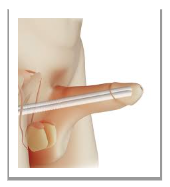
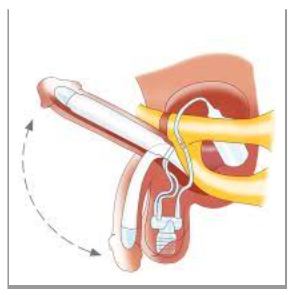
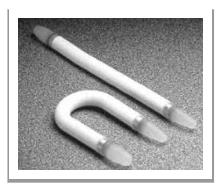
These implants contain flexible metal or silicone rods that can be manually bent upward or downward.

Structure:

  • Two flexible rods are placed inside the penis

  • Patients can manually position the penis upward for intercourse and downward afterward

Advantages:

  • Requires a simpler surgical procedure

  • No risk of mechanical failure

  • Very easy to use; suitable for patients with limited hand dexterity

Disadvantages:

  • The penis may remain semi-rigid at all times, which can be uncomfortable or aesthetically undesirable for some patients

  • Does not provide the natural feel of erection and flaccidity
What Should Be Considered Before Penile Prosthesis (Penile Implant) Surgery?

Preoperative Preparation

Patient Selection:

  • The prosthesis is applied to patients who cannot achieve an erection with medication or injections.

  • Suitable for patients with erectile dysfunction due to diabetes, neurological disorders, or after prostate cancer treatment.

Examinations:

  • Risk of infection is evaluated (if there is a urinary tract infection or skin infection, the surgery is postponed).

  • Cardiac evaluation and tests for general anesthesia suitability are performed.

How Is Penile Prosthesis (Penile Implant) Surgery Performed?

The surgery usually takes between 45–90 minutes and is performed under general or spinal anesthesia.

1) Location of the Surgical Incision

  • Penoscrotal Approach: An incision is made at the lower part of the scrotum (most commonly used technique).

  • Suprapubic Approach: An incision is made above the base of the penis (preferred by some surgeons).

2) Placement of the Prosthesis

  • The natural erectile chambers of the penis, called the corpora cavernosa, are prepared.

  • The appropriate size of the chosen prosthesis is placed.

  • For inflatable prostheses: The pump is placed in the scrotum, and the reservoir is placed in the abdomen.

  • For malleable prostheses: Silicone rods are inserted into the penis to complete the procedure.

3) Closure and Recovery Process

  • The incisions are sutured, and antibiotics are given to prevent infection.

  • The patient typically stays in the hospital for one night, though in some cases same-day discharge is possible.

  • Full recovery takes 4–6 weeks, during which sexual activity is not recommended.

What Complications Can Occur After Penile Prosthesis (Penile Implant) Surgery?

Infection:
One of the most important complications. Antibiotic-coated prostheses reduce the risk of infection.
If an infection develops, the prosthesis may need to be removed.

Mechanical Failure of the Prosthesis:
Rarely, mechanical malfunction can occur, especially in inflatable prostheses.
In new-generation prostheses, durability usually ranges between 10–15 years.

Pain and Swelling:
Mild pain may occur during the first 1–2 weeks after surgery.
Painkillers and cold compresses can be used to manage discomfort.

Does the Penis Shrink After Penile Prosthesis Surgery?

  • Slight Shortening in Erection Length:
    Since the prosthesis replaces the natural spongy tissue inside the penis, a mild shortening may occur.
    However, when measured correctly, this difference is minimal.


Does Penile Prosthesis (Penile Implant) Provide a Natural Erection Feeling?

  • Inflatable prostheses provide the closest sensation to a natural erection.

  • Malleable prostheses remain semi-rigid at all times, so the natural feeling is somewhat reduced.


Is Sexual Sensation Affected After Penile Prosthesis Surgery?

  • The prosthesis only provides rigidity; it does not affect sexual sensation or orgasm.


Is the Penile Prosthesis Noticeable From the Outside?

  • Inflatable prostheses look normal when deflated.

  • Malleable prostheses may be slightly noticeable under tight clothing.


What Is the Lifespan of a Penile Prosthesis?

  • The average lifespan is 10–15 years.

  • If a mechanical failure occurs, revision surgery can be performed to replace the prosthesis.

Which Prosthesis Is Suitable for Whom?

Type of ProsthesisSuitable For
Three-Piece InflatableYounger to middle-aged, sexually active patients who want the most natural feel
Two-Piece InflatableMiddle-aged patients seeking an easier surgical procedure
Malleable (Bendable)Patients with limited hand dexterity, neurological disorders, or those preferring a simpler solution

Mesajınızı İletin

    ali şahin tasarım